
In This Issue
U.S. Equity Index Quarterly Outlook
Reports and Expiration Notices
From Elliott Wave International and E-Futures.com
Our newly designed tutorial is the most comprehensive introduction to the Elliott Wave Principle available in cyberspace. All ten lessons have been adapted from Prechter and Frost's Wall Street bestseller, Elliott Wave Principle — Key to Market Behavior.
After taking the Basic Tutorial, you will know:
The 3 rules and 3 guidelines that will set you apart from 99% of investors.
The fundamental wave formations and how you can identify them
How to construct and leverage channels on your charts .
What scale you should use when analyzing market action.
And much, much more...
The Basic Tutorial is just one of the many resources Elliott Wave International offers you as a member of Club EWI - the world's largest Elliott Wave community.
Join now - for FREE - and start the tutorial immediately. You'll also have instant access to special Club EWI articles, special offers and events.

from Man Global Research, Nick Kalivas
Executive Summary: The equity market appears cheap statistically, and should start to realize value as inflation expectations fall. Stocks have become more competitive to competing asset classes and investors stung in the commodity and real estate markets are likely to take another look at equities. The downside risk to the market rests in global monetary tightening, and the current dislocation in the real estate market leading to Japanese style deflation or a repeat of the 1990/1991 recession which was marked by a banking crisis.
Q4 Trade Idea: Buy NDZ6 1595/1600. Risk 1573 and target 1750.
Q3 Trade Idea: Sell the Russell 2000 and buy the S&P 500 (RTY/SPX) at a cash ratio of 0.5600 to .05700. Risk over 0.5800 and target 0.5500. The ratio is approximately 1.65 e-mini S&P 500 contracts to 1.0 e-mini Russell 2000 contract. Sold and met target for profit.
Overview
The equity market continues to trade cheap on the basis of long term interest rates and earnings. Stocks have been out of favor in recent years as speculative money has looked to housing and commodities for meaningful returns. With home price deflation a threat and short term borrowing costs higher, the outlook for capital gains in real estate has dimmed. Likewise, commodity returns have turned soured as contango price structures and already high prices reduce the outlook for positive returns. The Goldman Sachs Total Return Commodity Index has recently posted a negative year over year return, while press reports about hedge fund loss related to natural gas trades has caused investors to rethink commodity investing. Going forward, the stock market is in better position to attract speculative money. In recent quarters, corporate cash flow has been the main driver of equity appreciation with share buybacks and dividend payments hitting record levels. Mutual fund and ETF flows into the U.S. market have been lackluster underscoring the interest in competing asset classes. The souring outlook for real estate and commodity returns coupled with still low bond yields should cause investors to increase the weight of U.S. equities within their portfolios. The major downside risk to the equity market rests in global monetary tightening and real estate based deflation. Global liquidity has been reduced as monetary policy has been tightening in Asia, Europe, and North America. The U.S. banking system will be vulnerable to retrenchment and add to the liquidity crunch if real estate deflation takes hold of the economy.
Earnings Outlook
Earnings growth is expected to slow on the back of weaker global economic activity and the maturity of the economic cycle, but the level of earnings per share will remain high. The U.S. housing and auto sectors are creating a headwind to growth, while global monetary tightening is also lending pressure to economic activity in Europe and Asia. In recent weeks, Japanese economic numbers have been mixed, while comments from the Indian and Korean Finance Ministers have pointed to a throttling down in economic activity. Chinese bank lending has slowed as the government has worked to reign in fixed investment. European economic data has become more two-sided, while the ECB continues to drain liquidity in order to restrain activity. However, the decline in energy prices and the relatively low level of long term rates will help to cushion profit growth --especially outside of the energy sector. In fact, the developments in the energy and interest rate markets raise the probability of a soft landing scenario. Moreover, Microsoft's introduction of a new operating system, Vista, will help strength demand for technology product.
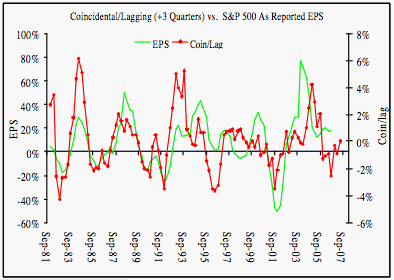
S&P 500 earnings estimates are buoyant. On an operating basis, the S&P 500 is expected to post earning growth of 13.1% in 2006 to a level of $86.46/share. Profits are forecast to rise another 12.2% to $97.02/share in 2007. More conservatively, S&P 500 EPS are forecast to rise 16% to $81.12 in 2006 on an as reported basis, but only 2% to $82.90 in 2007. Profit growth appears aggressive given the slowing pace of economic activity, but companies have been buying back shares and helping to lift earnings and there are signs that commodity costs are moderating. The managements of Proctor and Gamble, Conagra, and Masco have signaled lower commodity costs and hinted that the developments will be a plus for earnings growth. Currently, earnings estimates are most vulnerable in the energy sector due to falling energy prices. The financial sector could also be a risk if the yield curve remains inverted and weakness in residential real estate leads to the write down of real estate assets. Macro indicators of profit growth lean toward a deceleration in profit growth. First, the ratio of coincidental to lagging economic indicators points to slower earnings growth over the next two quarters, but profits should then recovery. However, there has been a divergence between the ratio of coincidental to lagging indicators and profit growth in recent quarters (see graphic). Notice that the recent sharp drop in the ratio failed to spark a major reduction in EPS growth. Share buyback activity, globalization, and distortions created by the 2005 hurricane season may be responsible for the divergence.
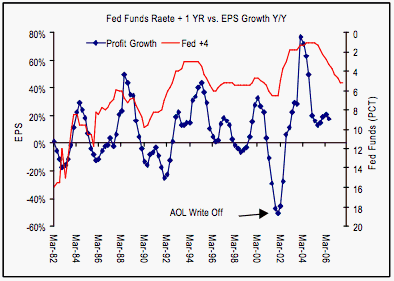
Second, the fed funds rate or the direction of monetary policy tends to lead corporate profit growth by about a year. Tighter monetary policy or rising short term interest rates slow profit growth, while looser monetary policy or falling short term interest rates leads to faster profit growth. The current trend in monetary policy argues for falling profit growth into mid 2007. The graphic explains the market's focus on the direction of monetary policy and its dislike for a tightening cycle.
Valuation Outlook
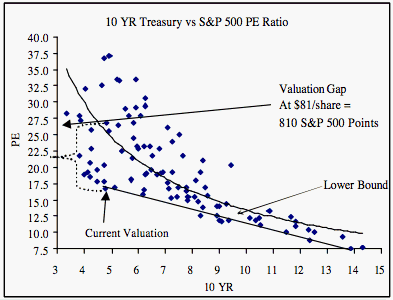
Equity valuation is typically driven by long term interest rates and inflation. A 10 year yield under 5.00% is supportive to equity valuation. The recent decline in gasoline prices could help boost economic activity, but the long end of the yield curve is likely to see yields under pressure as long as the auto and housing industries display difficult conditions. Historically, PE ratios have moved inversely to the level of the 10 year treasury. High yields lead to PE ratio compression while low yields lead to PE ratio expansion. The graphic displays the relationship between the PE ratio and the 10 year yield. Note in recent years the PE ratio has been compressed relative to the level of the 10 year yield. In fact, the deviation is becoming excessive and is on the lower band of the data points displayed. Based on the current conditions, the PE ratio could expand by about 10 points on the basis of as reported earnings. A 10 point PE expansion equates to over 800 points in S&P value. Granted, this projection may be aggressive due to the geopolitical risk premium in the market, and potential index related issues, but it underscore the stock market is cheaply valued.
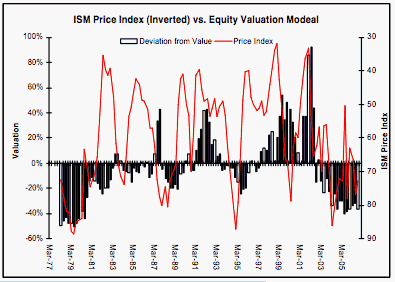
The graphic above displays the deviation of S&P 500's price from fair value. It is calculated by multiplying the PE by earnings per share for the S&P 500. The PE ratio is determined by the level of the 10 year treasury yield. The actual price is subtracted from the model price to determine the deviation from fair value. The market is extremely cheap basis the level of earnings and interest rates. It has not been this cheap since the late 1970's. In addition to valuation, the chart contains a picture of the ISM price index. It should be noted that equity market tends to trade at a discount to fair value when the ISM price index is high and a premium to fair value when the price index is low. High levels of inflation compress PE ratios, while low levels of inflation expand PE ratios.
The graphic implies that valuation will be realized if inflationary pressures fall. The current drop in commodity and housing prices should lift the market's PE ratio.
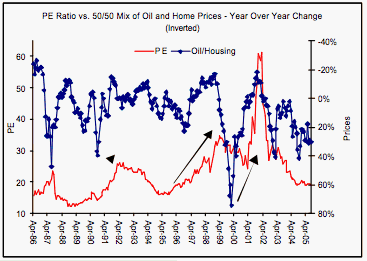
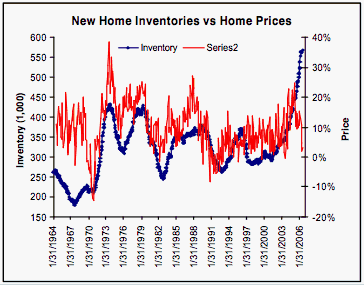
Historically, the PE ratio of the equity market has displayed a relationship to the price of oil and the price of existing housing. The graphic above displays the PE ratio of the S&P 500 verses a 50%-50% price mix of the year over year change in the price of oil and the price of existing homes. The price index shows deflation and predicts that the PE ratio of the S&P 500 will rise in the coming quarters. Home prices are likely to trend stagnate to lower in the coming year as the market works off excessive inventory. Given the high level of expected earnings per share, a few point gain in the market's PE ratio will lead to a powerful rise in stock prices.
Competing Markets
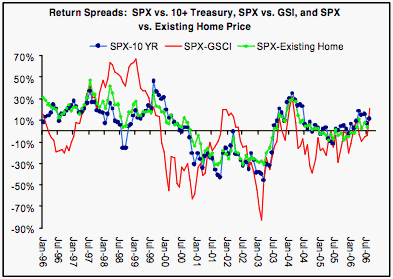
The equity market has to compete with other markets for investment money. Part of the sluggish price action in equities over the past few years has been a function of weak investment flows as the poor returns of the early 2000's and popping of the equity bubble caused investors to look elsewhere. Equity returns have become more competitive in recent months after a prolonged period of relative weakness. The S&P 500 has outpaced the 10 year treasury over the past six months, while home price appreciation is falling below the return on the S&P 500. At the same time, the return on the S&P 500 has improved relative to the Goldman Sachs Index. Going forward, it will tough for the GSCI to post strong returns given the already high level of commodity prices and the deteriorating technical condition of the market. Additionally, the carry market in crude oil (contango) will weigh on returns as funds are forced to buy high and sell low.
Corporate Cash Flow
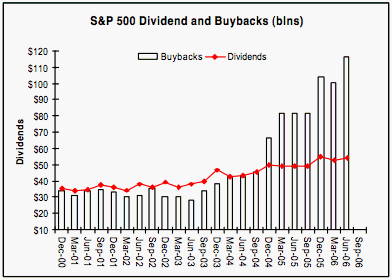
S&P 500 companies continue to return money to shareholders at an aggressive pace. According to S&P, share buybacks and dividend payments totaled $171 bln in Q2. Buyback activity has accelerated aggressively since late 2004, while dividend payments have been steadily increasing. Between Q2 2005 and Q2 2006, the market cap of the S&P 500 gained $800 bln. During the same period, dividend payments and buybacks totaled $612 bln. Over 75% of the increase in market cap came from corporate cash flow. Although the corporate sector has been bullish, mutual fund and ETF flows have been anemic into the U.S. market. From a contrary stand point companies see their shares as cheap, while the public seems cool toward the market. The mutual fund flows tend to be weakest at market bottoms and strongest at market tops.
Monetary & Housing Risks
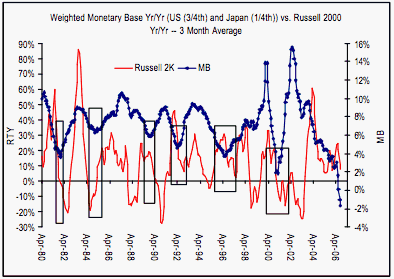
The biggest downside risks to the equity market rest in the loss of liquidity and the spreading of troubles in the housing market to the banking system and economy in general. Central banks across the global are tightening policy in order to fight inflation. Periods of tight monetary policy have tended to put downward pressure on equity prices. The graphic displays the relationship between the Japanese and U.S. monetary base, weighted for economic growth, against the year over year change in the Russell 2000. Note that contractions in the monetary base have led to a deceleration in the year over year change in equity prices. In some cases, stock prices turn negative year over year, but not in all cases. The current contraction in the monetary base is among the greatest in over 25 years. Moving to housing, the inventory of homes is at record levels and will lead to a reduction in building activity. Home prices are likely to be under pressure until there is a balance in the market. Additionally, builders are reviewing their land holdings. If home prices fall dramatically and land values become impaired, large write offs could occur. This may raise risk premiums in the banking system and lead to a reduction in general bank lending - a credit crunch. The 1990/1991 recession and banking crisis may act as a potential analog.
Bank lending in the real estate sector has expanded over the past year. Real estate lending, in all forms, was up $452 bln at FDIC banks between Q2 2005 and Q2 2006 highlighting the excess exposure to real estate. Bank stocks, which typically trade strong when treasury yields are falling, have failed to make a meaningful high since May and keep pace with the recent treasury market rally. This could signal a pick up in risk premium.
Change in FDIC Bank Lending in Trln $
| Real Estate | C&I | Individual | |
| Q2 2006 | $4.383 | $1.164 | $0.933 |
| Q2 2005 | $3.932 | $1.042 | $0.907 |
| Change | $0.451 | $0.122 | $0.026 |
A Technical Note
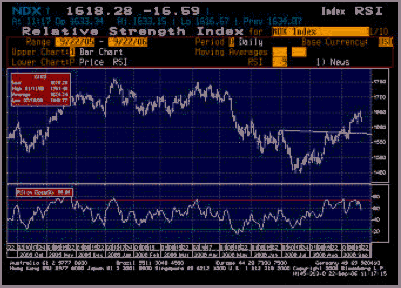
The NASDAQ 100 is overbought near term as the 9 day RSI is at an extreme level. The market needs to work off its overbought condition before a long position can be entered. The September expiration and sharp drop in crude oil prices led to an extreme rally. Technically, a retest of the trend line should be used as a buy point (see chart). The cash chart was used to avoid roll issues and provide rich RSI history.
Disclaimer:
Trading commodity futures and options involves substantial risk of loss. The recommendations contained in this letter is of opinion only and does not guarantee any profits. These are risky markets and only risk capital should be used. Past performances are not necessarily indicative of future results. This is not a solicitation of any order to buy or sell, but a current futures market view provided by Cannon Trading Inc. Any statement of facts herein contained are derived from sources believed to be reliable, but are not guaranteed as to accuracy, nor they purport to be complete. No responsibility is assumed with respect to any such statement or with respect to any expression of opinion herein contained. Readers are urged to exercise their own judgment in trading!
Source: Moore Research Center, Inc.
| Date | Reports | Expiration & Notice Dates |
|---|---|---|
| 09/21 Thu |
7:30 AM CDT - USDA Weekly Export Sales
7:30 AM CDT - Initial Claims-Weekly 9:00 AM CDT - Leading Indicators(Aug) 9:30 AM CDT - EIA Gas Storage 11:00 AM CDT - Philadelphia Fed(Sep) 2:00 PM CDT - Cold Storage 3:30 PM CDT - Money Supply |
LT: Sep Value Line(KCBT)
|
| 09/28 Thu |
7:30 AM CDT - GDP-Final & Chain Deflator-Final(Q2) 7:30 AM CDT - USDA Weekly Export Sales 7:30 AM CDT - Initial Claims-Weekly 9:00 AM CDT - Help-Wanted Index(Aug) 9:30 AM CDT - EIA Gas Storage 3:30 PM CDT - Money Supply |
FN: Oct Soybean Oil & Meal(CBT)
Oct Natural Gas(NYM) LT: Sep Feeder Cattle(CME) Sep Feeder Cattle Options(CME) |
| 09/29 Fri |
7:30 AM CDT - Grain Stocks 7:30 AM CDT - Personal Income(Aug) 7:30 AM CDT - Personal Spending(Aug) 8:50 AM CDT - Michigan Sentiment-Rev(Sep) 9:00 AM CDT - Chicago PMI(Sep) 2:00 PM CDT - Quarterly Hogs & Pigs 2:00 PM CDT - Dairy Products Prices |
FN: Oct Gold(CMX)
Oct Silver(CMX) Oct Copper(CMX) Oct Platinum(NYM) Oct Palladium(NYM) LT: Sep U.S. 2 Yr T-Notes(CBT) Sep Fed Funds(CBT) Oct Sugar(NYBOT) Oct Heating Oil(NYM) Oct Unleaded Gas(NYM) Oct Lumber Options(CME) |
| 10/02 Mon |
9:00 AM CDT - Construction Spending(Aug)
9:00 AM CDT - ISM Index(Sep) |
FN: Oct Sugar(NYBT)
|
| 10/03 Tue |
Auto & Truck Sales
|
FN: Oct Heating Oil(NYM)
Oct Unleaded Gas(NYM) |
| 10/04 Wed |
9:00 AM CDT - Factory Orders(Aug)
9:00 AM CDT - ISM Services(Sep) 9:30 AM CDT - API & DOE Energy Stats |
|
| 10/05 Thu |
7:30 AM CDT - USDA Weekly Export Sales
7:30 AM CDT - Initial Claims-Weekly 9:30 AM CDT - EIA Gas Storage 3:30 PM CDT - Money Supply |
|
* Please note that the information contained in this letter is intended for clients, prospective clients, and audiences who have a basic understanding, familiarity, and interest in the futures markets.
** The material contained in this letter is of opinion only and does not guarantee any profits. These are risky markets and only risk capital should be used. Past performances are not necessarily indicative of future results.
*** This is not a solicitation of any order to buy or sell, but a current market view provided by Cannon Trading Inc. Any statement of facts herein contained are derived from sources believed to be reliable, but are not guaranteed as to accuracy, nor they purport to be complete. No responsibility is assumed with respect to any such statement or with respect to any expression of opinion herein contained. Readers are urged to exercise their own judgment in trading!