
In This Issue
Special Report: A Yield Curve Inversion
Reports and Expiration Notices
Clean market data. Industry respected support. Innovative technology. It's what you've come to expect from FutureSource. Now you can expect even more, with FutureSource real-time products!
In conjunction with Cannon Trading, FutureSource would like to offer you a free trial to one of our Real-Time Products! PLUS - receive 10% off the subscription price!
Streaming Real-Time Charting — Tick-by-tick, intra-day, daily, weekly, monthly and continuation charts
Interactive Charts — with 30+ indicators, multiple drawing tools, and so much more!
Streaming Real-Time Quotes from over 40 exchanges with 60+ customizable headings
Real-Time News — full real-time commodity coverage from industry leading news services!
Data Download Facility!
Dynamic Time & Sales with customizable color preferences available
Complete Weather Package!
To take advantage of this money-saving offer, simply click here.
By Nick Kalivas, Man Financial
A few weeks back, MGR looked at the impact of an inverted coupon curve (2YR/10YR spread) on the price of equities and 10 year treasuries. The greatest conclusion of the study was an ensuing rally in the 10 year market (yields tended to decline). The future shape of the curve and direction of the equity market were mixed in the period after the start of the inversion. The yield curve now looks set to invert between the fed funds rate and the 10 year treasury. The Fed is widely expected to raise the fed funds rate 25 bps to 4.50% at the January 31st FOMC meeting. The 10 year treasury is currently yielding 4.36%. Thus, assuming no change in the 10 year yield, the 10 year yield will be 14 bps below the fed funds target. Inversion is unusual, but has occurred in a number of periods: 2000, 1998, 1989, 1986, 1978, and 1973. The curve also experienced dramatic volatility which included inversion during the 1979 to 1982 period as the Federal Reserve fought inflation. The use of reserve targeting may cause the inversion of 1980 to be an outlier or exception to the rule. This period is included in our analysis but with caution. Trying to project the events during the 1970's, 1980's, and 1990's on today's markets may also be dangerous, as factors driving the global economy have changed overtime. The advent of Asian savings and trend in Petrodollars can influence the shave of the curve over time. However, each period will be exampled for impact on equity and debt prices. Weekly data, over a 19 week time period from the first week of inversion was used to study the markets. Bloomberg data was used to target the fed funds rate.
Quick Period Summary
1973
The curve inverted in March 1973 and continued to invert for 19 weeks through July 1973. During this time period, the 10 year treasury yield increased 5.7% from the first week of inversion. The 10 year yield rose from 6.67% to 7.05%. Yields were up and down in a fairly tight range during the first 10 weeks, but then increased overtime. During this period, the fed funds rate rose from 6.75% to 9.50% and the yield curve inverted 245 bps. Looking at equities, the S&P 500 lost 7.30% over the 19 week period. It should be noted that President Nixon started to feel the heat of Watergate in the March/April time period of 1973. Televised hearings began May 17, 1973.
1978
The curve inverted in September 1978. In the 19 weeks following the inversion, the fed funds rate went 115 bps over the 10 year treasury. The 10 year treasury yield rose 9.7% over the 19 week time period increasing from 8.34% to 9.15%. The fed funds rate increased from 8.375% to 10.00% over the same period. 10 year yields glided higher over time. The S&P 500 lost 6.6% over the period with heavy losses eight to ten weeks from inversion. The equity market was down 11.5% at its worst.
1980
The curve inverted in September 1980. The inversion reached almost 775 bps in December 1980, as the fed funds rate reached 20%. The fed funds rate was volatile during the period starting at 12% reaching 20% and then finishing the 19 week period at 16%. The 10 year yield rose 9.2% over the period, but did fall in the week following the inversion by almost 5%. The S&P 500 rose 3.4% across the 19 week period. However, prices were up over 11% 10 weeks past the inversion. The shift in Fed policy benefited stocks.
1986
The curve briefly inverted in April of 1986 and then steepened quickly. The curve widened 120 bps during the 19 week time frame. The 10 year treasury yield fell 1.5% across the period, but the yield backed up seven to eight weeks out. 10 year yield rose 14.7% working form 7.02% to 8.05%. The fed funds rate dropped from 7.25% to 5.875% during the period. The S&P 500 rose 4.35% across the 19 week period, but did suffer a peak loss of nearly 4% in the four weeks after the inversion.
1989
The curve inverted in February 1989 and continued to invert through the period of measure. The inversion hit 155 bps in late June 1989. The 10 year treasury yield fell 12% across the period declining from 9.20% to 8.08%. The fed funds target rose from 9.375% to a peak of 9.75% and then finished the 19 week period at 9.625%. The S&P 500 rose 7% across the period of measure; however, stocks posted a peak gain of 10.5%. Stock prices were soft in the early portion of the inversion and then rose between 7 and 19 weeks. A shift in Fed policy helped stocks.
1998
The curve inverted in June of 1998. The effects of the Asian crisis seemed to force an inversion. In the wake of the inversion, the 10 year treasury yield fell as much as 20% with yields declining from 5.43% to a low of 4.28% in the week of October 2nd. However, yields did rise through October as the Fed worked to cut interest rates from 5.50% to 5.00%. The 10 year yield ended the 19 week period at 4.70%. The yield on the 10 year treasury has heavily influenced by the position of the LTCM. During the 19 week time period, the equity market finished 2.5% lower, but trade was volatile. The S&P 500 initially rallied as much as 8%, but then fall as much as 11%.
2000
The curve inverted in April 2000. It quickly normalized in May steepening 50 bps, but then inverted again to a level of 73 bps at the end of the 19 week period. During this period, the 10 year treasury yield rose, but the largest increase occurred fives weeks after the initial inversion. The yield rose from 5.85% to 6.49%. At the end of the 19 week period, the yield had fallen to 5.77%. Equity prices declined very quickly after the inversion, but then pared losses. The decline at the end of the 19 week period was 1.6%. This period saw the end of the technology bubble.
Conclusion and More Details
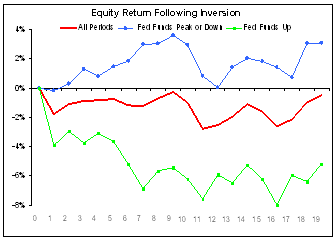
The direction of monetary policy plays a role in the reaction of the equity market to the inversion. If the Fed is near an end of the rate hike cycle, the equity market tends to post positive returns in the period following the inversion. However, the equity market tends to decline post the inversion if the fed is still lifting rates. The graphic displays the return by classification of the trend in monetary policy. The fed funds rate peaked during the inversion of 1980 and 1989 and was plain cut in 1986 and 1998. The Fed was lifting rates through the inversions in 1973, 1978, and 2000.
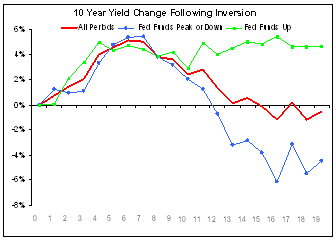
The direction of monetary policy also plays in roll in the direction of the 10 year treasury yield. On average, the 10 year yield tends to rise in the few weeks following the inversion. However, yields will drop if the Fed is cutting rates and will rise if the Fed is lifting rates. The graphic below displays the return by classification of the trend in monetary policy. The fed funds rate peaked during the inversion in 1980 and 1989 and was plain cut in 1986 and 1998. The Fed was lifting rates during the inversions of 1973, 1978, and 2000. Trying to project this history on current times may be difficult as the long end of the curve has not shown correlation to the direction of monetary policy in recent years. Thus, a Fed rate cut or change in Fed policy toward ease may not necessarily lead to lower yields, while further rate hikes may not cause yields to rise.
Right now it appears that Fed policy will be data driven past the January 31st FOMC meeting. It is difficult to predict if the rate hike cycle is finished or in a pattern similar to the 1980 or 1989 periods when the Fed transitioned from hiking rates to cutting rates. Given the mixture of economic events, MGR Equity leans toward thinking the rate hike cycle is in transition. If so, the equity market could trade well through the spring. Treasury yields should also drop, but MGR is less confident given the debt market's action prior to the inversion.
Disclaimer: There is a risk of financial loss in futures and options trading. Futures trading is neither easy nor an easy way to make money. It takes hard work to have success. Please use sound money management when trading futures. Past performance is not necessarily indicative of future results. Nothing in this newsletter is intended to be a trading recommendation for you to buy or sell futures or options. All information has been obtained from sources believed to be reliable, but accuracy is not guaranteed. Readers are solely responsible for how they use the information in this newsletter.
Source: Moore Research Center, Inc.
| Date | Reports | Expiration & Notice Dates |
|---|---|---|
| 01/26 Thu |
7:30 AM CST - Cotton Consumption
7:30 AM CST - Durable Orders(Dec) 7:30 AM CST - USDA Weekly Export Sales 7:30 AM CST - Initial Claims-Weekly 9:00 AM CST - Help-Wanted Index-Dec 9:30 AM CST - EIA Gas Storage 3:30 PM CST - Money Supply |
LT: Jan Feeder Cattle(CME)
Jan Feeder Cattle Options(CME) Feb Gold Options(CMX) Feb Heating Oil Options(NYM) Feb Unleaded Gas Options(NYM) Feb Natural Gas Options(NYM) |
| 01/27 Fri |
7:30 AM CST - Dairy Products Prices
7:30 AM CST - GDP-Adv(Q4) 7:30 AM CST - Chain Deflator-Adv(Q4) 9:00 AM CST - New Home Sales(Dec) 2:00 PM CST - Cattle Inventory |
LT: Jan Palladium(NYM)
Jan Platinum(NYM) Feb Natural Gas(NYM) Feb CBT Grains Options(CBT) Feb CBT Beans/Rice Options(CBT) Feb Spring Wheat Options(MGE) Feb Wheat Options(KCBT) Feb US TBond Options(CBT) Feb US 10,5,2 Yr T-Notes Options(CBT) |
| 01/30 Mon |
7:30 AM CST - Personal Income & Spending(Dec)
|
|
| 01/31 Tue |
7:30 AM CST - Employment Cost Index(Q4)
9:00 AM CST - Chicago PMI(Jan) 9:00 AM CST - Consumer Confidence(Jan) 1:15 PM CST - FOMC Meeting |
FN: Feb Gold(CMX)
LT: Jan 30 Day Fed Funds(CBT) Jan Live Cattle(CME) Feb Heating Oil(NYM) Feb Unleaded Gas(NYM) Feb Propane(NYM) Feb Lumber Options(CME) |
| 02/01 Wed |
9:00 AM CST - Construction Spending(Jan)
9:00 AM CST - ISM Manufacturing Index( 9:30 AM CST - API & DOE Energy Stats Auto & Truck Sales(Jan) |
|
| 02/02 Thu |
7:30 AM CST - Productivity-Prel(Q4)
7:30 AM CST - USDA Weekly Export Sales 7:30 AM CST - Initial Claims-Weekly 9:30 AM CST - EIA Gas Storage 3:30 PM CST - Money Supply |
LT: Jan Milk(CME)
|
* Please note that the information contained in this letter is intended for clients, prospective clients, and audiences who have a basic understanding, familiarity, and interest in the futures markets.
** The material contained in this letter is of opinion only and does not guarantee any profits. These are risky markets and only risk capital should be used. Past performances are not necessarily indicative of future results.
*** This is not a solicitation of any order to buy or sell, but a current market view provided by Cannon Trading Inc. Any statement of facts herein contained are derived from sources believed to be reliable, but are not guaranteed as to accuracy, nor they purport to be complete. No responsibility is assumed with respect to any such statement or with respect to any expression of opinion herein contained. Readers are urged to exercise their own judgment in trading!